
Table of Contents
Every sales quote is a commitment to the customer to deliver the right product, in the right quantity, at the right time. That commitment is hardest to keep in design-to-order, make-to-order, and assemble-to-order environments, where even a well-planned promise can unravel at any stage of execution.

Three risks stand between the quote and the fulfillment of what is promised in the quote.
Risk 1 — The risk of unrealistic promise. Sales teams often make customer commitments without a complete view of engineering schedules, inventory, production capacity, supplier constraints, or competing operational priorities. In many organizations, the rest of the business does not begin planning for an order until after the commitment has already been made to the customer.
Risk 2 — The risk of disruption. The harder problem begins once the customer accepts the quote. Material shortages, design challenges, procurement delays, production issues, quality problems, logistics disruptions, engineering changes, and shifting priorities can all put the commitment at risk.
Risk 3 — The risk of doing nothing. The disruption is visible, but no coordinated response to work around the disruption follows. Teams see the problem and cannot act on it.

Over the past decade, visibility solutions have significantly improved organizations’ ability to detect disruptions and identify orders at risk. That progress has been valuable, but it primarily addresses Risk 2 —helping organizations see that a disruption has occurred.
The more difficult challenges remain Risk 1 and Risk 3.
Recent advances in supply chain situational awareness, AI agents, and workflow orchestration make it possible to address these challenges in ways that were simply not practical a few years ago. Organizations can now continuously make sense of changing operational conditions across engineering, procurement, manufacturing, logistics, suppliers, and customer orders, recommend the most effective responses, and coordinate execution across cross-functional teams before customer commitments are impacted.
Together, these capabilities enable organizations to address all three risks throughout the quote-to-fulfillment process.
- Commit realistically. Enable sales teams to make achievable commitments based on current operational conditions and forward-looking supply chain insight.
- Monitor continuously. Track the events, dependencies, and risks that could affect customer orders throughout the quote-to-fulfillment process.
- Orchestrate the response. Proactively alert the right teams, recommend corrective actions, and coordinate execution across the organization and the broader supply chain before customer commitments are missed.
Implementing Quote-to-Cash Situational Awareness
Many organizations use CRM/CPQ (Salesforce, for example) to manage customer opportunities, configure products, and generate quotes, while engineering and ERP systems like SAP manage product lifecycle, procurement, manufacturing, inventory, logistics, and order fulfillment.

Sales and commercial teams naturally focus on customer opportunities, pricing, configurations, and quotes within Salesforce. Their objective is to win business and make commitments that meet customer expectations.
The operational reality, however, exists elsewhere in engineering, procurement, manufacturing, inventory, logistics, and supplier networks managed by SAP and other enterprise systems. In many organizations, the teams responsible for fulfilling the commitment do not begin planning until after the quote has been accepted and converted into a sales order.
As a result, customer commitments are often made without a complete understanding of the operational conditions required to fulfill them. Even after an order is created, sales and operational teams continue to work with different views of the business as conditions evolve.
As a result, implementing quote-to-fulfillment situational awareness is less about integrating systems and more about connecting business decisions with operational reality. It starts by giving sales teams the operational context needed to make realistic customer commitments, then continuously evaluate those commitments as conditions change and coordinate the organization’s response whenever they are at risk.
The following sections describe how this can be implemented using Salesforce CRM, CPQ, SAP, Engineering, Sourcing Systems, supply chain situational awareness, AI agents, and workflow orchestration.
Step 1 – Bring Operational Context into Sales Process
The first step is enabling sales teams to make customer commitments with a clear understanding of the organization’s current operational capabilities.
Instead of relying solely on customer requirements, pricing, and product configuration, every quote should also be evaluated against the operational factors that determine whether the commitment can actually be fulfilled.
That operational context may include:
- Available and projected inventory
- Engineering and design status
- Pricing and cost profiles
- Production capacity and existing commitments
- Supplier availability and delivery performance
- Material shortages and supply chain risks
- Quality holds and manufacturing constraints
- Transportation and logistics considerations
- Customer priority and contractual commitments
Rather than requiring sales teams to search multiple systems or involve planners before every quote, this information should be continuously summarized and presented within Salesforce as actionable operational insights (as shown below).

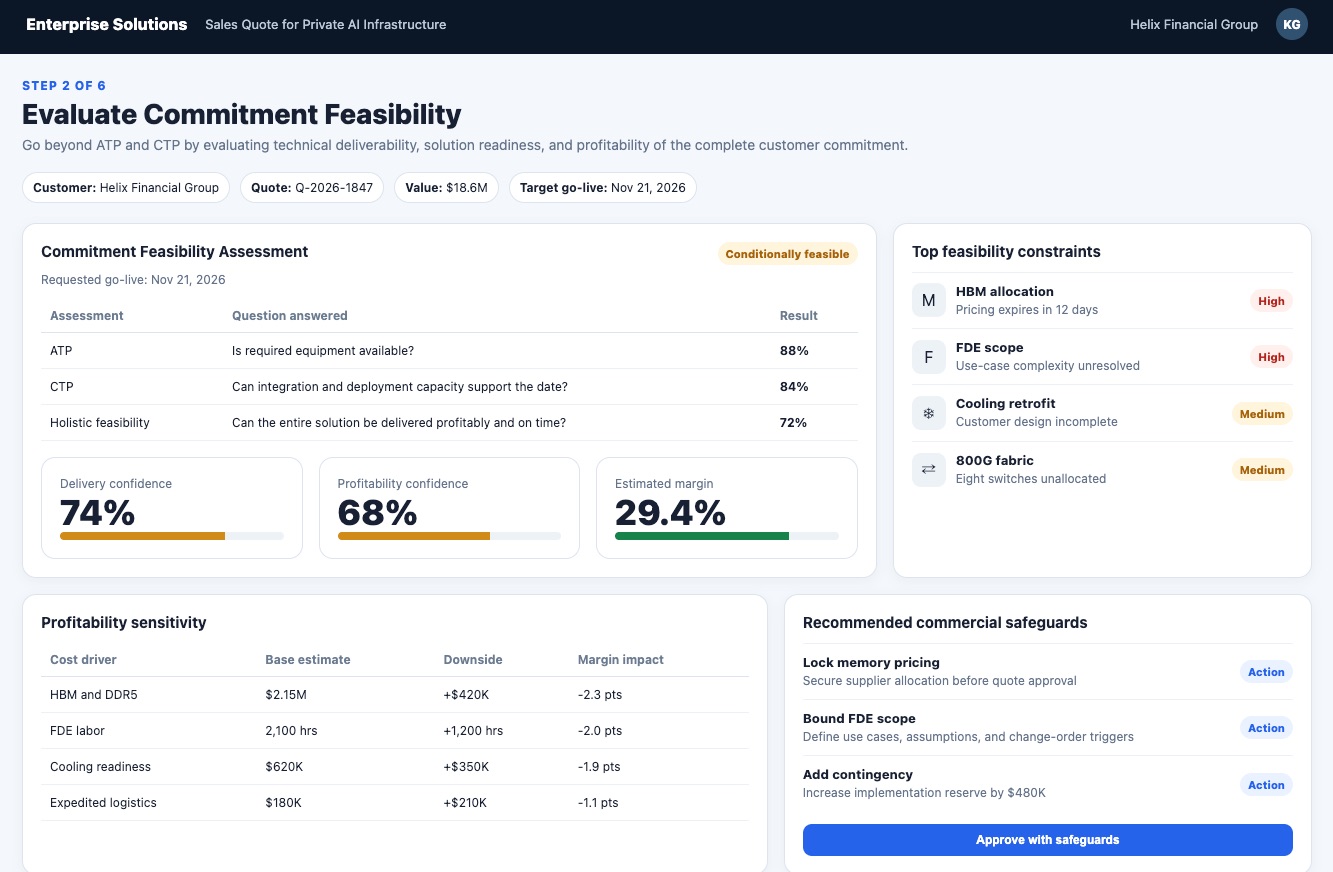
Step 2 – Evaluate the Feasibility of the Customer Commitment
Bringing operational context into Salesforce gives sales teams greater visibility into the factors that influence customer commitments. The next step is determining whether the proposed commitment is actually achievable.
Most ERP systems provide capabilities such as Available-to-Promise (ATP) and, in some cases, Capable-to-Promise (CTP). These capabilities are valuable, but they evaluate only part of the information required to determine whether a customer commitment can realistically be fulfilled.
ATP primarily evaluates inventory availability. CTP extends that assessment by considering manufacturing capacity and production constraints. For many manufacturers, however, the feasibility of a customer commitment depends on far more than inventory and capacity.
Engineering activities may still be in progress. Critical suppliers may need to be qualified. Material shortages may affect key components. Quality holds may restrict available inventory. Existing customer commitments may already consume constrained production capacity. Transportation limitations, engineering changes, and supplier performance can all influence whether a promised delivery date can actually be achieved.
Instead of evaluating these factors independently, organizations should assess the overall feasibility of the customer commitment using the complete operational context assembled in Step 1.
That assessment may consider:
- Available and projected inventory
- Engineering and design readiness
- Production capacity and existing commitments
- Supplier availability and delivery performance
- Material shortages and supply chain risks
- Quality holds and manufacturing constraints
- Transportation and logistics considerations
- Customer priority and contractual commitments
Step 3 – Create a Digital Thread of Sales Order Fulfillment
Once the customer accepts the quote, the focus shifts from making a commitment to fulfilling it.
In most ERP systems, the sales order primarily serves as a transactional record that drives downstream business processes. While essential, it does not provide a continuously evolving understanding of everything required to fulfill the commitment.
A more effective approach is to make the sales order the center of a living order fulfillment digital thread that connects the customer commitment to every operational activity, dependency, and business event involved in fulfilling it, including product configuration and components, engineering and qualification effort, available inventory, PO commitments, supply capacity, and more.
Rather than existing as isolated transactions across multiple enterprise systems, these activities become part of a continuously evolving representation of the sales order.

As operational conditions change, the digital thread changes with them. Every engineering change, supplier delay, inventory movement, production event, quality issue, or logistics update immediately becomes part of the operational context for that specific sales order.
Step 4 – Continuously Assess Sales Order Fulfillment Risk
Creating a living order fulfillment digital thread provides the operational context for each sales order. The next step is continuously assessing whether changing conditions put that order at risk.
Order fulfillment rarely follows the exact plan established when the sales order is created. Supplier dates move, engineering work takes longer than expected, inventory is consumed by competing priorities, production schedules change, quality issues emerge, and transportation capacity becomes constrained.
Each of these changes may appear first as an isolated event in SAP or another operational system. Its real significance, however, depends on which sales orders are affected and whether the organization can still meet the promised delivery date.
The digital thread makes it possible to evaluate every operational event in the context of the sales order.
Events may include:
- A supplier changing a committed delivery date
- A purchase order or inbound shipment being delayed
- A critical component falling below projected demand
- An engineering change affecting the product configuration
- A production order starting late
- A machine or production line becoming unavailable
- A quality inspection failing or inventory being placed on hold
- A transportation booking being cancelled or delayed
- Another customer order receiving higher priority
As these events occur, the organization can continuously reassess:
- Which sales orders are affected
- Which products, quantities, and delivery dates are exposed
- Which materials, suppliers, plants, and activities are creating the risk
- How fulfillment confidence has changed
- How much time remains to respond before the customer is affected
AI agents can help distinguish meaningful risks from routine operational noise. Rather than generating an alert for every change, they can evaluate the event against the sales order’s dependencies, delivery requirements, available alternatives, and current execution state.

For example, a three-day supplier delay may have no impact when sufficient inventory is available. The same delay may place a sales order at immediate risk when the material is single-sourced, inventory is depleted, and production is scheduled to begin the following day.
Step 5 – Evaluate Response Options
Identifying that a sales order is at risk is only the beginning. The more difficult challenge is determining what the organization should do next.
In most companies, response planning depends on a series of calls, emails, meetings, and manual analyses across planning, procurement, engineering, manufacturing, logistics, sales, and customer service. By the time the organization agrees on a response, the available options may have narrowed and the customer commitment may already be in jeopardy.
AI agents can accelerate this process by evaluating the current state of the sales order digital thread and identifying practical response options.
Depending on the nature of the disruption, those options may include:
- Reallocating available inventory from another order or location
- Expediting a supplier delivery
- Identifying an alternate supplier or substitute material
- Moving production to another line or plant
- Rescheduling production priorities
- Splitting the order into multiple shipments
- Changing the transportation method
- Accelerating an engineering or quality approval
- Renegotiating the delivery commitment with the customer
Each response option should be evaluated against multiple business considerations, including:
- Likelihood of protecting the promised delivery date
- Cost of the response
- Impact on other customer orders
- Supplier and manufacturing feasibility
- Customer priority and contractual obligations
- Time available to act
- Operational risk introduced by the response
Rather than presenting a single recommendation without explanation, AI agents can provide multiple response scenarios with the assumptions, trade-offs, confidence level, expected cost, and customer impact associated with each option.

For example, an agent may determine that expediting a supplier shipment would preserve the original delivery date at an additional cost, while shifting production to another plant would provide greater confidence but affect another customer order. A split shipment may protect the customer’s most urgent requirement while allowing the remaining quantity to follow later.
Step 6 – Orchestrate the Response Across the Organization and Supply Chain
A recommended response creates value only when the organization can execute it quickly.
Most fulfillment risks cannot be resolved by a single team. Protecting a customer commitment may require procurement to expedite a supplier, planning to reserve capacity, engineering to approve a change, manufacturing to adjust its schedule, logistics to secure transportation, and sales or customer service to communicate with the customer.
Without orchestration, these activities are often managed through disconnected emails, spreadsheets, meetings, and individual follow-ups. Teams may agree on the response but still fail to execute it in time.
Workflow orchestration turns the selected response into a coordinated execution plan.

For example, a decision to expedite a constrained component may trigger coordinated actions for procurement, the supplier, inbound logistics, production planning, and finance. Each team receives the information and task relevant to its role, while the overall response remains connected to the affected sales order and customer delivery date.
Conclusion
Operationally speaking every sales quote has a question mark. Can we realistically deliver what we are about to promise?
For many organizations, the answer is still based on fragmented information, isolated planning processes, and assumptions that may no longer be true by the time the order reaches manufacturing.
Supply chain visibility has helped organizations recognize when orders are at risk. The next evolution is enabling organizations to make better commitments in the first place, continuously understand how changing operational conditions affect those commitments, and coordinate an effective response before customers are impacted.
This requires more than connecting Salesforce and SAP. It requires connecting commercial decisions with operational reality.
By bringing operational context into Salesforce, evaluating the feasibility of customer commitments, creating a living sales order fulfillment digital thread, continuously assessing fulfillment risk, using AI agents to recommend the best response, and orchestrating execution across the organization, companies can move from reacting to disruptions to proactively protecting every customer commitment.
The future of quote-to-cash is not simply greater transaction speed and visibility. It is continuous situational awareness, AI-assisted decision making, and cross-functional orchestration working together to ensure that every customer commitment has the greatest possible chance of becoming a successful delivery.
You must be logged in to post a comment.